Hey, I don't normally post a lot on this site, but I feel the need to give this rant as I have an issue with people requesting buyers to send PayPal payments over friends and family and how they use this as a way to protect themselves from chargebacks & fees.
Friends and family protects me from chargebacks:
No it doesn't. On the 22nd of September (not even a week ago), I was scammed $160 USD from "Seth Sabo" who appears to have ban evaded twice now on this site. I regret not doing my research on this user prior to the transaction. Basically I was purchasing mineprime.com's network files. After sending the payment he essentially ignored all my Skype messages and has continued to do so. I was still able to get this payment reversed, despite the nature of the payment.
The advantages of business accounts:
I have a verified PayPal account, but this isn't any typical verified account, it is also a business account with tax/business information included with it. When kids pull shit like this against business accounts, PayPal will almost always side with the buyer. So today I called PayPal and explained the whole situation and how the seller deliberately asked me to send as F&F for a goods & services type of payment, to avoid fees. I also told them the seller was in violation of section 4.1 of PayPal's ToS, which I will get into in this next section. After the employee spoke with his supervisor, case was opened.
You're violating PayPal's user agreement:
Whether you know it or not, asking your buyer to send his payment over friends and family for a goods and services type of payment is in violation of section 4.1 of PayPal's user agreement.

Source: https://www.paypal.com/ca/webapps/mpp/ua/useragreement-full
As the bullet says, this may restrict your ability to accept F&F payments, ultimately resulting in no choice but to only accept goods and services payments (which is what it should of been all along).
What you should do as a seller:
Obviously, stop asking your buyer to send as friends and family. I don't care how shady the buyer seems or how worried you are about disputes. Either way, if your end intentions are to scam your buyer, your buyer will win no matter how hard you try to avoid the situation. Now there's the situation where the buyer tries to scam the seller, and there's only two real scenarios at play here. If the buyer tries to chargeback on the seller when the transaction was legitimate, then read my next section. But if the seller sends the goods and doesn't receive payment from buyer, this is at the fault of the seller, not buyer. Buyer should always go first, or at least 50% upfront payment.
How to avoid fraud on both ends:
For sellers, I advise sending your buyer a PayPal invoice. In this invoice, describe that the nature of the goods the buyer is purchasing is intangible, electronic goods (if it is like a build or something) or development services (if it is plugin development etc). Describe how the files/services are being delivered (ex. Google Drive), explain how the buyer fully authorizes and understands the nature of this payment, and if a chargeback is initiated the buyer is attempting to obtain said software/services illegitimately. If it is a service, I would also include expected completion date.
Example:
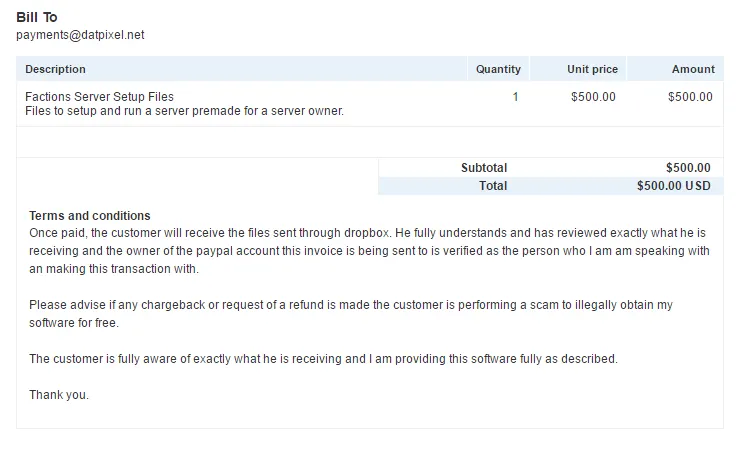
This provides both protection for seller and buyer. In the event the seller scams the buyer, the buyer can fight with the information provided in the invoice with PayPal whether it be not as described, or not received. If it is a service, the invoice should specify the expected due date, and if it is past this, the buyer can use this information against the seller. For digital goods, if the product you received did not match the invoice description, you can of course use this as the dispute reason. In the event your buyer scams you, the information provided in the invoice provides an in-depth explanation of exactly what was being purchased, and upon disputing PayPal staff can review this.
Closing:
Tl;dr do not request your buyer to send payments as F&F when the nature of the purchase is goods and services. This will not protect you if you decide to scam your buyer, and more importantly it could limit your account to no longer receive personal payments if you are caught. As always I'd recommend sending your buyer an invoice with an in-depth description of what exactly is being purchased. Of course, there are some transaction sizes where doing such is silly, such as $5. But to some people on this site $5 is a lot of money. So that's all for now, hope this gives you an insight on how to conduct future business with your buyers in a way that isn't totally shady.
~ Steven
Friends and family protects me from chargebacks:
No it doesn't. On the 22nd of September (not even a week ago), I was scammed $160 USD from "Seth Sabo" who appears to have ban evaded twice now on this site. I regret not doing my research on this user prior to the transaction. Basically I was purchasing mineprime.com's network files. After sending the payment he essentially ignored all my Skype messages and has continued to do so. I was still able to get this payment reversed, despite the nature of the payment.
The advantages of business accounts:
I have a verified PayPal account, but this isn't any typical verified account, it is also a business account with tax/business information included with it. When kids pull shit like this against business accounts, PayPal will almost always side with the buyer. So today I called PayPal and explained the whole situation and how the seller deliberately asked me to send as F&F for a goods & services type of payment, to avoid fees. I also told them the seller was in violation of section 4.1 of PayPal's ToS, which I will get into in this next section. After the employee spoke with his supervisor, case was opened.
You're violating PayPal's user agreement:
Whether you know it or not, asking your buyer to send his payment over friends and family for a goods and services type of payment is in violation of section 4.1 of PayPal's user agreement.
Source: https://www.paypal.com/ca/webapps/mpp/ua/useragreement-full
As the bullet says, this may restrict your ability to accept F&F payments, ultimately resulting in no choice but to only accept goods and services payments (which is what it should of been all along).
What you should do as a seller:
Obviously, stop asking your buyer to send as friends and family. I don't care how shady the buyer seems or how worried you are about disputes. Either way, if your end intentions are to scam your buyer, your buyer will win no matter how hard you try to avoid the situation. Now there's the situation where the buyer tries to scam the seller, and there's only two real scenarios at play here. If the buyer tries to chargeback on the seller when the transaction was legitimate, then read my next section. But if the seller sends the goods and doesn't receive payment from buyer, this is at the fault of the seller, not buyer. Buyer should always go first, or at least 50% upfront payment.
How to avoid fraud on both ends:
For sellers, I advise sending your buyer a PayPal invoice. In this invoice, describe that the nature of the goods the buyer is purchasing is intangible, electronic goods (if it is like a build or something) or development services (if it is plugin development etc). Describe how the files/services are being delivered (ex. Google Drive), explain how the buyer fully authorizes and understands the nature of this payment, and if a chargeback is initiated the buyer is attempting to obtain said software/services illegitimately. If it is a service, I would also include expected completion date.
Example:
This provides both protection for seller and buyer. In the event the seller scams the buyer, the buyer can fight with the information provided in the invoice with PayPal whether it be not as described, or not received. If it is a service, the invoice should specify the expected due date, and if it is past this, the buyer can use this information against the seller. For digital goods, if the product you received did not match the invoice description, you can of course use this as the dispute reason. In the event your buyer scams you, the information provided in the invoice provides an in-depth explanation of exactly what was being purchased, and upon disputing PayPal staff can review this.
Closing:
Tl;dr do not request your buyer to send payments as F&F when the nature of the purchase is goods and services. This will not protect you if you decide to scam your buyer, and more importantly it could limit your account to no longer receive personal payments if you are caught. As always I'd recommend sending your buyer an invoice with an in-depth description of what exactly is being purchased. Of course, there are some transaction sizes where doing such is silly, such as $5. But to some people on this site $5 is a lot of money. So that's all for now, hope this gives you an insight on how to conduct future business with your buyers in a way that isn't totally shady.
~ Steven
Last edited: